
Healing After Sexual Assault
There is a moment many survivors know well: the quiet realization that something happened that changed the landscape of your life.
Healing after sexual assault rarely unfolds in a straight line.
It moves more like weather—sometimes calm, sometimes turbulent, sometimes filled with unexpected light.
Sexual violence affects millions of people every year. In the United States, someone is sexually assaulted about every 68 seconds, and many survivors experience long-lasting emotional impacts such as anxiety, depression, post-traumatic stress symptoms, or Rape Trauma Syndrome (RTS). Yet these statistics tell only part of the story. Behind each number is a human being navigating grief, confusion, anger, courage, and resilience.
One of the most important truths survivors often need to hear is this: your reactions are not signs of weakness—they are signs of a nervous system trying to protect you. Trauma can alter how the brain and body respond to stress, leaving survivors feeling on edge, disconnected, or overwhelmed long after the event itself. These responses are natural adaptations to harm.
Healing begins when survivors are given the space to name what happened without shame.
In my book, Sexual Assault from A-Z: A Guide to Terminology and Resources for Survivors and their Allies, I write about the importance of language. Naming experiences—whether words like boundaries, consent, or survivor—can help people reclaim meaning and shift the weight of blame back where it belongs: with the person who caused harm.
But healing is not only cognitive. It is also deeply embodied.
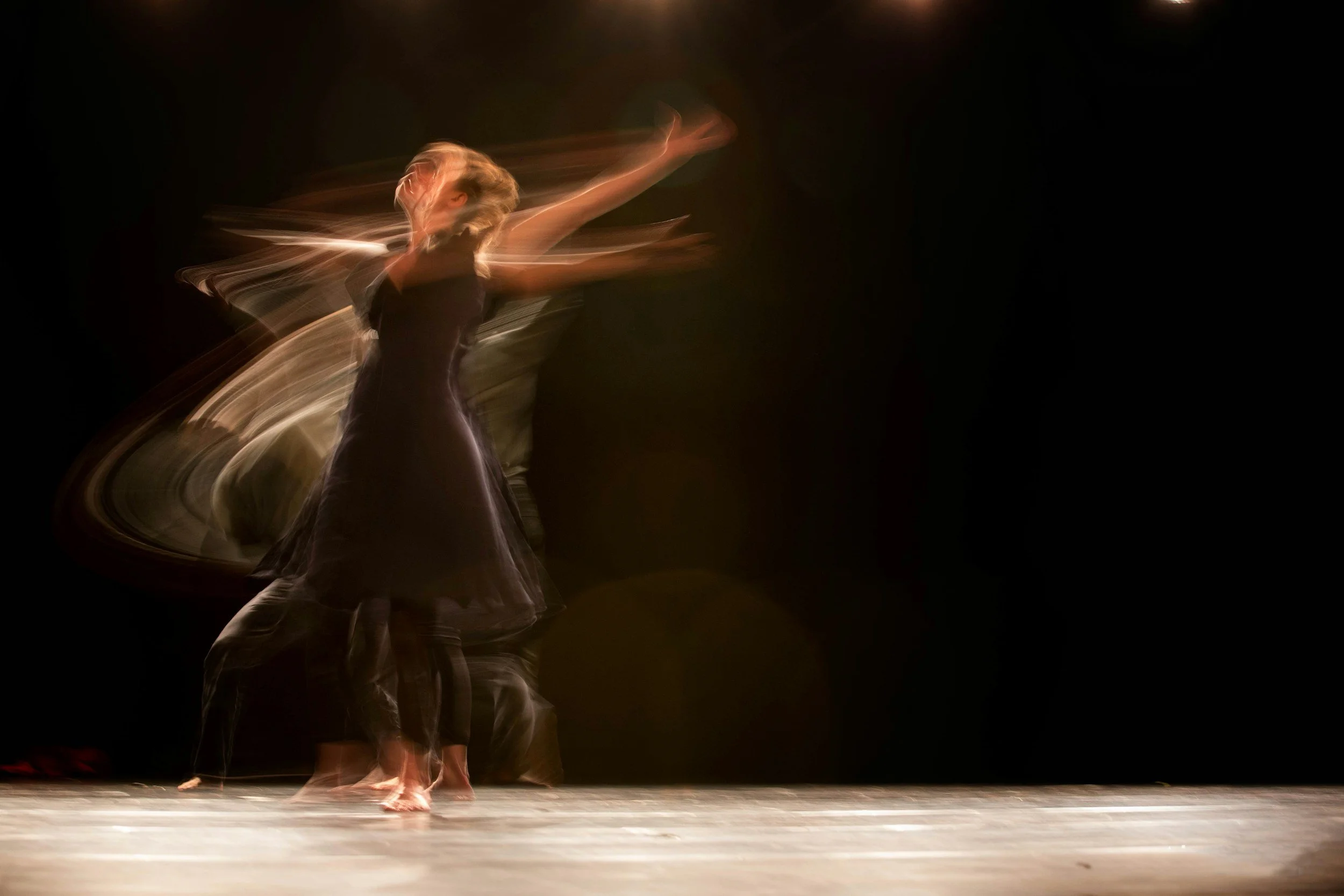
A dancer with blonde hair and a dark dress is captured mid-movement with a time-lapse lens, while dancing across a stage with a black background. Her movements are blurred and dynamic.
Many survivors discover that the body holds memories that words cannot easily reach. This is why trauma-informed therapies often include approaches that engage the nervous system directly—such as EMDR, somatic therapies, and expressive arts practices. Research shows that creative expression can help survivors process trauma and reduce symptoms of anxiety and distress by giving emotions a nonverbal outlet.
Creativity becomes a bridge between the unspeakable and the imaginable.
Organizations like RAINN and Resilience remind survivors that healing is not something anyone has to do alone. Support—whether through therapy, community resources, or trusted relationships—plays a powerful role in recovery.
At Roots and Rays Creative Counseling, we often speak about healing as a process of reclaiming authorship over one’s story. Trauma may shape the chapters of a life, but it does not get to write the ending.
Resilience grows quietly, often in small moments:
a deep breath,
a conversation that feels safe,
a boundary spoken aloud,
a return to creativity.
Art Therapy Prompt: Symbols of Strength
This exercise invites you to create a visual reminder of the strength that already lives within you. You can use paper, markers, colored pencils, collage materials, paint, or —whatever feels most natural in your hands.
Begin by creating a circle in the center of your page. This circle represents the core of your resilience—the part of you that endured, adapted, and kept going even in the face of harm.
Inside the circle, create or collage a symbol of your strength. It might be an animal that feels protective or powerful, a plant that represents growth, a flame, a mountain, a shield, or something completely abstract. Let your intuition guide you. There is no right or wrong image here—only what feels true.
Once your central symbol is complete, begin building outward from the circle. Around your symbol, add colors, shapes, textures, or patterns that represent the strengths that helped you survive. These might include courage, anger, intuition, compassion, humor, creativity, or the support of others. Allow the space around your symbol to grow into a mandala—a circular design that radiates outward from the center.
You might choose to create a protective boundary around your central symbol. This boundary can represent safety, self-protection, or the limits you now hold around your energy and wellbeing. It could appear as a ring of thorns, shields, waves, light, or geometric shapes—anything that symbolizes protection and sovereignty.
As you continue working outward, imagine your strength expanding to the edges of the page. Add vibrant colors, repeating shapes, or patterns that amplify the energy of the central symbol. Notice how far your strength can reach. Let the mandala grow as large as it needs to.
You may also choose to add words or phrases that affirm your resilience. These might be quiet reminders or bold declarations—your own warrior mantras. For example:
I survived.
My voice matters.
My body belongs to me.
I am stronger than what happened.
I carry wisdom.
When you feel complete, take a moment to sit with your image. Notice the colors, shapes, and symbols that emerged.
Gently ask yourself:
How can I carry this strength with me beyond the page?
Your artwork becomes a visual witness to your resilience—a reminder that even after harm, strength continues to grow outward, reaching farther than you may have imagined.